by Goodvalf Vana Goodvalf Vana

GATE VALVES

Gate Valves

Gate valves are multi-turn valves widely used in industrial applications. They are available in various sizes, materials, temperature and pressure ratings, as well as different body and bonnet designs. Gate valves are designed to operate in either a fully open or fully closed position. Therefore, they are not suitable for throttling or flow regulation applications and should not be used for precise flow control.

Gate valves are typically used where minimal pressure loss and a full, unobstructed bore are required. When fully open, the gate does not obstruct the flow path, resulting in very low pressure drop. As a multi-turn valve, a gate valve operates via a threaded stem mechanism. The stem must be rotated several times to move the gate from the open to the closed position. This slow operation also helps reduce the risk of water hammer.

Gate valves control flow by means of a sliding gate or disc that moves perpendicular to the flow direction. They are suitable for applications involving hot water, compressed air, fuels, and a wide range of chemical fluids.

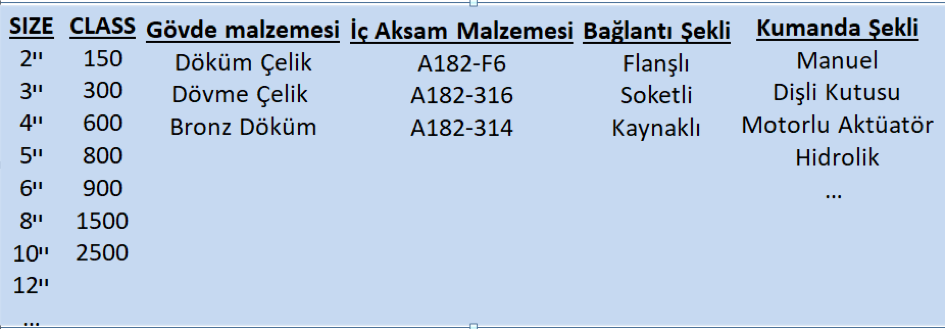
Gate valves are manufactured in accordance with ANSI standards, specifically API 600 and API 602. When selecting or requesting a gate valve, the following information should be specified:
This image has an empty alt attribute; its file name is gatevana.png

Advantages of Gate Valves

  • They can be used for bidirectional flow.
  • They are cost-effective and readily available.
  • They provide excellent shut-off performance.
  • They provide straight-through flow.
  • They offer very low flow resistance.

Disadvantages of Gate Valves

  • They are not suitable for rapid opening and closing operations.
  • Not appropriate for precise flow control
  • Not recommended for applications requiring tight sealing in all conditions
  • Requires more maintenance and installation space
  • It requires clean fluid conditions. Since the sealing surfaces are in continuous contact and subject to friction, contaminated fluids may introduce particles between the surfaces, leading to wear, surface damage, and potential leakage. Therefore, proper filtration is essential.
by Goodvalf Vana Goodvalf Vana

Industrial Valve Manufacturing

Entire Proses of Industrial Valve Manufacturing

Industrial valve production is a comprehensive process starting from the valve design to the delivery of the valves produced to the customers. Throughout the process, quality control tests are carried out at all stages and production is carried out according to industry quality standards. The manufacturing process can be considered in six main categories: design, modeling, casting, machining, assembly and quality testing.

Industrial Valve Production Processes

Design

Industrial valve production starts with the design phase. During the design, the competent engineers, according to the customer wishes to design the valve on the computer. The prepared valves are tested for different usage scenarios in the computer environment.

Modeling

This step involves the preparation of molds for the production of valves prepared and tested in the computer environment. These models, called the casting model, form the basic molds for which the valves will be produced.

Casting

The first stage of production is used by using the casting models prepared during the modeling phase. Casting lines are casted in different weights according to the usage area. Depending on the type of the valve produced during the casting process, it can be a single body production or in the form of parts.

Machining

After casting, the valves are processed on CNC machines to eliminate any roughness. After the machining process, the processed valve is sent to the next stage and the resulting waste is converted to gray and included in the production process.

Assembly

Valve parts produced separately can be mounted manually or by machines depending on the time required by the installation. During the assembly process, the finished products are sent to the painting line. During the dyeing process, different processes are performed according to different needs. For example, the valves to be used in drinking water lines use special paints that comply with the drinking water health regulations and standards. In addition, oil or natural gas will be used in the valves of these materials are used in appropriate paints.

Quality Control Test

The final stage of industrial valve production processes is the quality control test. At this stage, all quality tests in the leak test, hydrostatic pressure test and related regulations are applied before the products are delivered to the customer. Test results are reported in detail and these reports are sent to the relevant production units.

Packaging & Delivery

After completing the quality control tests of the produced valves, they are packed for delivery to customers and ready for delivery. The valves are packaged in a special way and sent to the customers after the measures taken against the damage that may occur during transportation.